

GENERATIONAL LONGEVITY SHIFT AND INHERITANCE
The world is facing an aging shift that will be more relevant for Millennials and Gen Z than for their parents: they are the first cohort expected to live to 100 and, at the same time, they are the first generation that will grow old while their parent’s generation is still alive.
Click HERE to access the full text.

Longevity and Inheritance
Life expectancy for the affluent is nearing 100 years in the United States. This is positive for individuals’ well-being, but it carries financial implications. For wealthy families, using resources to ensure that life expectancy is not jeopardized should be a priority.
Click HERE to access the full text.
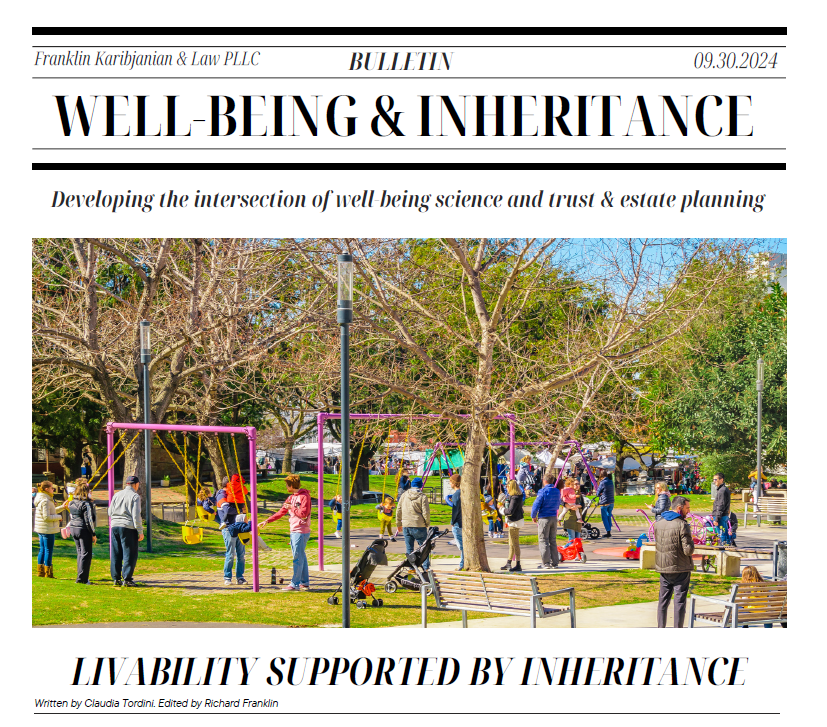
Livability Supported by Inheritance
Where an individual lives has such an impact on their well-being that it can be the difference between “a good life and a great one.”
In this edition of the Well-Being & Inheritance Bulletin we dive into "community" as a determinant of better well-being, including an individual’s engagement with the people and space where they live.
Click HERE to access the full text.

THE WARREN BUFFETT INHERITANCE MYTH
In this edition of the bulletin, we focus on understanding the evolution of Warren Buffett with respect to inheritance and his children through the lens of well-being science.
The natural and healthy process of growth in a person is to evolve toward psychological and emotional maturity and global wisdom. Warren Buffett is no exception. Fortunately, his ideas about inheritance have evolved too.
Read more to learn how Warren Buffet has moved away from his idea of giving ''enough money so that they would feel they could do anything, but not so much that they could do nothing'' to believing that “the amount of money that a rich person leaves with their children is [not] the determining factor at all in terms of how those children turnout.”
Click HERE to access the full text.

TIME FOR FAMILY AND FRIENDS SUPPORTED BY INHERITANCE
WHY SHOULD YOUR INHERITANCE PLANNING PROVIDE FOR SOCIAL WELL-BEING?
High quality social relationships that provide trust and social support, continue to appear as particularly important for well-being. People with the highest level of well-being are the ones who enjoy robust social connections.
Social connectedness benefits health more than other well-known factors such as exercise, physical fitness and not smoking. Group membership and social trust are associated with lower levels of mortality and higher levels of resilience.
Click HERE to access the full text.

GIVING AND RECEIVING INHERITANCE. TRUE LOVE OR SELF-INTEREST?
In this bulletin, we are expanding the lens on social exchange theory to explore motivations for family inheritance and their impact on family well-being.
Click HERE to access the full text.

STEWARDSHIP, INHERTIANCE & WELL-BEING
What happens when family stewards meet their family trusts and estate documents? Stewardship has become a commodity in family wealth management and preservation. However, is stewardship being part of family wealth management and estate planning best for everyone’s well-being?
In this bulletin, we invite you to explore the intersection of stewardship, inheritance and well-being and find the answers to this question.
Click HERE to access the full text.

INHERITANCE PLANNING PROMOTING CAREER WELL-BEING
“Career is one of the most important projects in people’s lives.”
It is also a main concern in inheritance planning as many parents fear that money may harm their children’s engagement in a successful career. So much so that the use of legal vehicles such as incentive trusts and limited inheritance is common among wealthy families.
Click HERE to access the full text.

INHERITANCE PLANNING SUPPORTING FINANCIAL EFFICACY
What is the difference between estate planning supporting a beneficiary financially and estate planning supporting a beneficiary’s financial well-being?
The difference is not a minor detail when it comes to inheritance planning. Each interpretation will yield a different approach to when, how and how much to give to your children.
Click HERE to access the full text.

INHERITANCE PLANNING SUPPORTING FINANCIAL WELL-BEING
The focus of the estate planning should be to inspire, encourage, and support autonomous motivation by facilitating autonomy, competence, and relatedness – the three basic psychological needs we presented in our December 2023 Bulletin.
Click HERE to access the full text.

WHEN CAN CHARITABLE GIVING SUPPORT DONOR WELL-BEING?
With the emergence of positive psychology and well-being science, a new angle of study offers insights on the benefits of giving for the charitable donor.
Learn about the elements and components of well-being science that can be incorporated in your estate planning and support well-being for you and your family members.
Click HERE to access the full text.
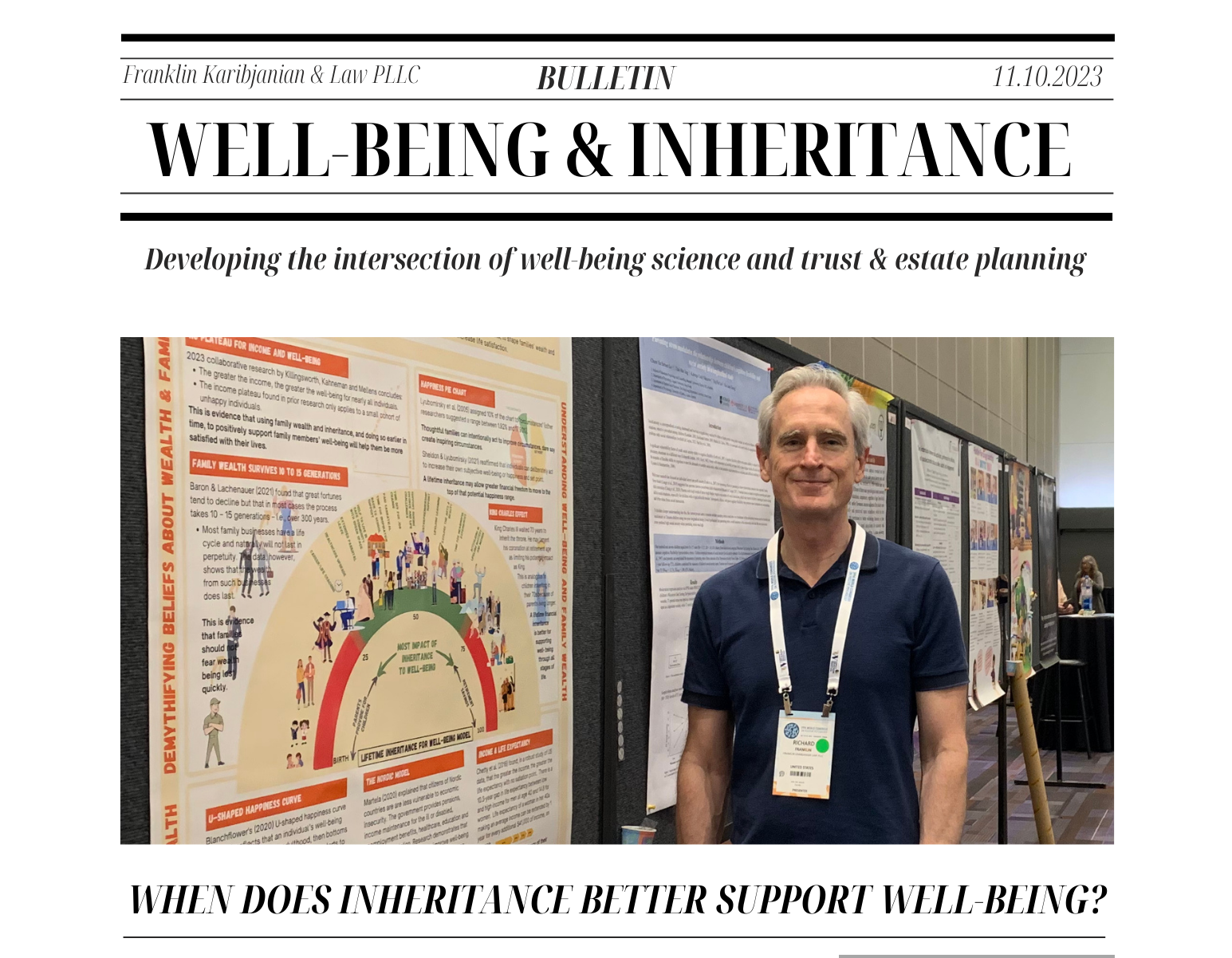
When Should You Give Inheritance Money to Your Kids?
A key concept we tell parents is that money is more helpful to children’s well-being at earlier stages of adulthood rather than at later ones. We draw on seven sources of research and empirical data to support our Lifetime Inheritance for Well-Being Model.
Learn about the LIFETIME INHERITANCE FOR WELL-BEING MODEL in the November 2023 edition of the Well-Being & Inheritance Bulletin.
Click HERE to access the full text.